
The Thin Red Line (1998)






Can war be poetic?
Presentation:
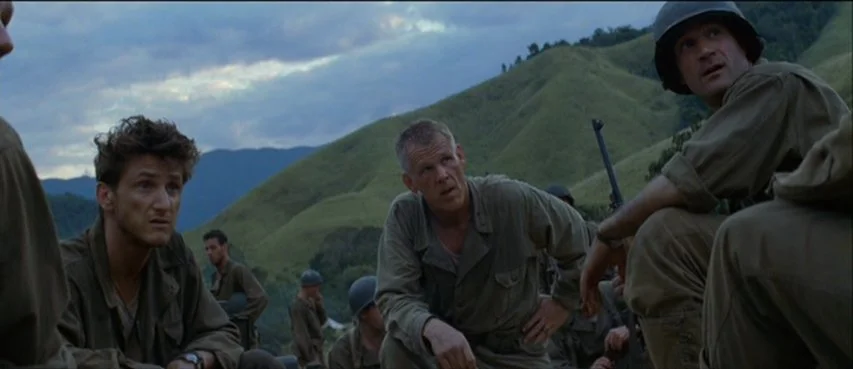
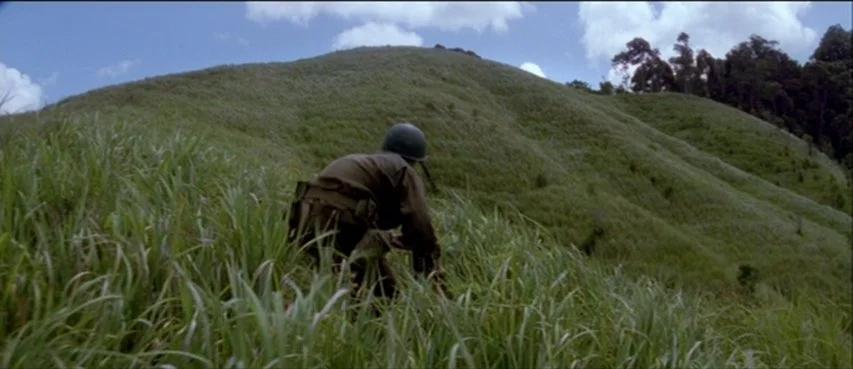
Deep focus anamorphic, Terrence Malick creates a beautiful film not only visually by stylistically. Set during World War II in the Guadacanal conflict with the Americans and Japanese, the film primarily focuses on a battle atop a beautiful ridge as well as a few other locations. The contrast between war and the naturally lit rolling hills of grass creates very striking visuals as the scenes are shot at sunset, blue hour and day time with light peeking through artificial clouds and canopies of trees. It’s visually very impressive especially for 1998 and I think looks almost as good as war films today. Terrence Malick’s visual language is prominent throughout this entire film, often intercutting shots of landscapes, animals and nature. Handheld work is stabilized and floaty with the occasional creative angle. The film incorporates many narrative sections, which are mostly stream of conscious and vague commentary on the philosophical aspects of war. Unlike other subversive dark war themes, Malick utilizes more of his signature seeking of truth style instead.
Conclusion:
This film is no different than any other Malick film, except it’s recycled in a war setting. If you’ve watched any other Malick film, you already know what to expect and whether you will like this film or not. The war aspect of the film is really captivating, but the consistent narration and crying was borderline insufferable at times. If you like this film, it’ll be beautiful, poetic, sensitive, profound. If you roll your eyes at it, it’ll be emotionally effeminate, pretentious, esoteric, heavy handed. One thing is for certain, this film is self indulgent and you can basically see a reflection of Malick and his existential journey through the characters. The director piloting this movie is really present in every frame and dialogue, it’s very evident of Malick’s own estrangement from society that he inappropriately forces in too many scenes. It even feels self-congratulatory as if he’s the only person to see the world for its hypocrisy and beauty, patting himself on the back on how insightful he is. Malick has every right to explore the sensitive side of man, but in this setting ends up being mostly misplaced, soldiers sobbing and selectively dying over dead bodies while being too didactic on anti-establishment while being pretentiously obscure in every narration. It’s undoubtedly unique, but if you don’t mind a constant barrage of quasi-philosophical prattle, you should find the war sequences stunning.
Recommendations









When Terrence Malick makes a film rather than a diary.